

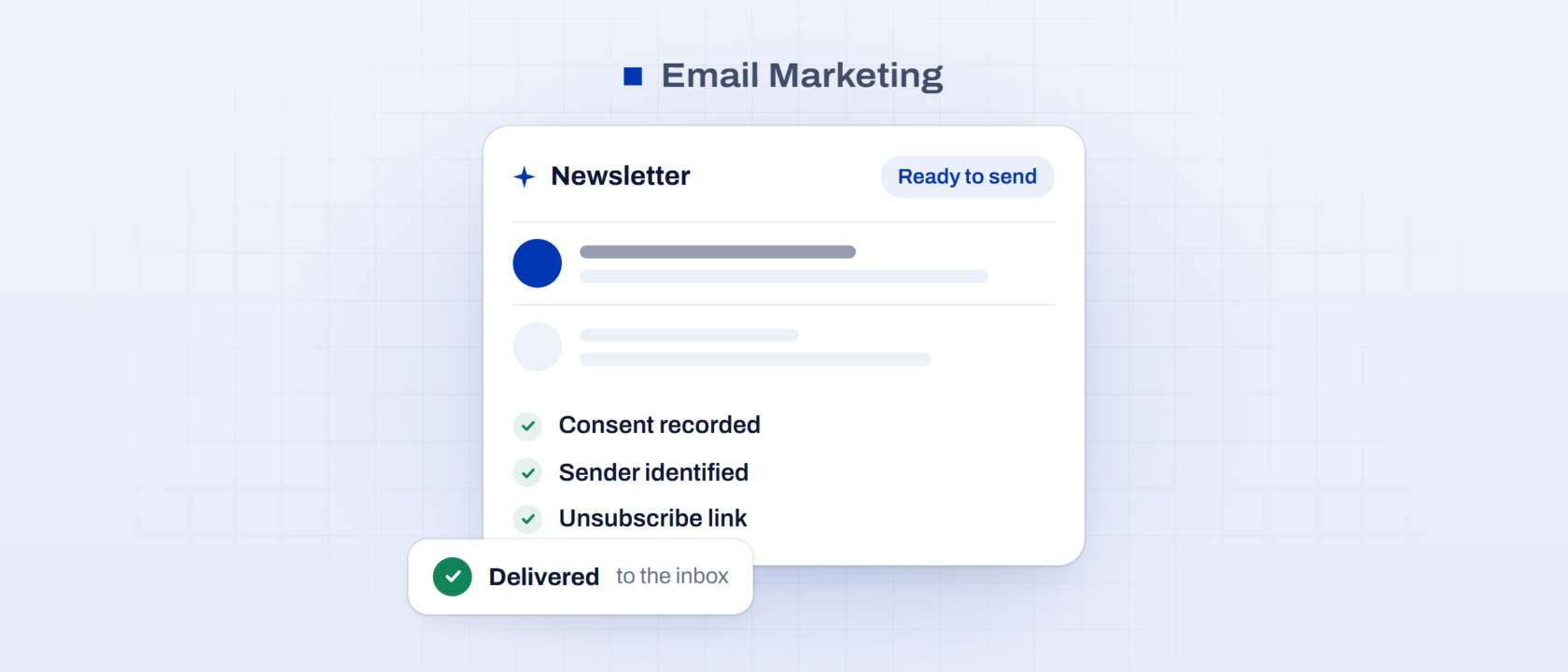
Email Marketing is one of the most effective marketing channels. According to Litmus Report, marketers generate $36 for each dollar spent on email marketing, a 3600% ROI. We experience this as consumers daily. A personalized email with the right promo delivered at the right time will nudge us to take action.

the Controlling the Assault of Non-Solicited Pornography And Marketing (CAN-SPAM) Act of 2003.
The Act regulates commercial emails, outlines the obligations for commercial messages, grants recipients the authority to opt out of receiving emails, and imposes severe penalties for any breaches.
The CAN-SPAM Act applies to bulk emails and commercial messages that advertise or promote a product or service, even if directed toward businesses. So, all emails must comply with this law. Failure to comply with the CAN-SPAM Act can be expensive, as every individual email violating the law may incur penalties of up to $53,088, according to the Federal Trade Commission.
Let’s examine the primary obligations of CAN-SPAM in more detail.
7 Essential Compliance Requirements Under the CAN-SPAM Act
- Email header information should be accurate and correctly identify the sender or business in the “From,” “To,” and “Reply-To” fields, as well as in the routing information. Misleading information should be avoided.
- When sending a message, the subject line should not be misleading and should accurately represent the content of the message.
- When sending promotional emails, it’s crucial to make it clear that it’s an advertisement. While there’s some flexibility in how you can do this, it’s a legal requirement.
- Include your physical postal address in your email to ensure clarity. This will inform the recipient of your location.
- To allow recipients to opt out of receiving future emails from you, it is essential to clearly and conspicuously explain the process in your message. Ensure to provide instructions on how to opt out of receiving emails from you.
- When a recipient requests to opt-out, honoring their request within ten business days is vital.
- Watching what others are doing on your behalf regarding email marketing is essential. The law states that even if you hire another company to handle it, you’re still responsible for following the legal requirements.
Navigating Email Marketing Laws in Canada
The primary law regulating email marketing in Canada is the Canadian Anti-Spam Legislation (CASL). This law is even stricter than the CAN-SPAM Act.
CASL was introduced in 2014 to establish email marketing standards and combat spam, identity theft, phishing, and malware. Its implementation has led to notable progress. In 2014, Canada had 7 of the top 100 spamming organizations globally, but as of 2019, there are none based in the country.
CASL has brought about considerable improvements in businesses since its establishment.
Initially, CASL compelled companies to adopt stricter measures in their electronic marketing, requiring them to seek consent before sending commercial electronic messages. This respects consumer privacy and ensures engagement with genuinely interested parties. Consequently, Canadian businesses benefit from high-quality email lists yielding strong open and click-through rates.
So, CASL is vital for establishing trust and creating business economic opportunities in the digital world. Now, we’ll take a closer look at its basic principles.
CASL: 4 Fundamental Principles

- send someone commercial electronic messages (CEMs), you must have their consent either explicitly or implicitly. Explicit consent is given when someone actively agrees to receive CEMs through a form or checkbox. Implicit consent is established when there is an existing business relationship.
- When sending a message, it is essential to identify yourself and anyone else on whose behalf the message is being sent.
- Every CEM sent should provide a simple and quick process for recipients to unsubscribe from future messages. The mechanism for unsubscribing should be easy to use.
- As per regulations, companies must maintain records of the consent they receive from recipients to demonstrate that they are authorized to send them commercial electronic messages (CEMs).
The Bottom Line from Roman Agency
Businesses in the USA and Canada must adhere to email marketing regulations effectively and ethically engage customers. By complying with these regulations, companies can build trust and respect with their customers while also improving the effectiveness of their marketing efforts by connecting with interested individuals.
Although laws regarding digital communication can be complex and constantly changing, it is advisable to seek guidance from legal experts, marketing agencies, or up-to-date resources to ensure your business fully complies with the latest regulations. This will safeguard your business and maintain high standards in digital communication.
Let us enhance your email marketing strategies with personalized solutions and professional guidance. Our team of experts can help you navigate email marketing regulations for efficient and compliant campaigns. Contact us now.
Texts follow different rules
Text messages are covered by a different US law, the Telephone Consumer Protection Act. Under the FCC’s rules, marketing texts need the recipient’s prior express written consent, and a person can withdraw consent in any reasonable way (FCC order 24-24, February 2024). For senior living communities that follow up with families by email and text, our senior living inquiry follow-up page explains how we set it up, with texts only where the family agreed.
Disclaimer: We are a marketing company, not a legal one. Nothing in this article constitutes legal advice; all information, content, and materials available on this site are for general informational purposes only.

Roman ZelvenschiChief Storyteller
Roman Zelvenschi is a digital marketing strategist and founder with over 15 years of experience helping businesses grow through data-driven marketing and brand strategy. Since 2008, he has turned ideas into profitable, scalable ventures—working with brands ranging from global enterprises like Mondelēz to startups such as The Kosher Express. His expertise lies in SEO, AI-driven marketing, and lead generation, particularly within highly regulated industries such as healthcare, long-term care, and finance. Roman believes effective marketing blends brand investment for long-term growth with short-term performance through lead generation and customer lifetime value optimization. An early adopter of AI in marketing, Roman has leveraged machine learning since 2022 to enhance targeting, personalization, and campaign performance. He continues to advocate that technology should amplify human creativity—not replace it.
Schedule a Call