
A Place for Mom and Caring.com are free for families because senior living communities pay them. A Place for Mom is paid by the community when a family it referred moves in, and its website has described that fee as the resident’s “first month’s rent and care.” Caring.com is paid either when a family moves in or each time it passes on a family’s contact details, depending on the provider’s contract. Neither company lists its rates where its website explains how it is paid.
At the national median price for assisted living, $6,200 a month in CareScout’s 2025 survey, a fee equal to the first month comes to $6,200 per new resident. For an operator with five communities, our worked example below puts the total between about $149,000 and $372,000 a year, depending on how many residents arrive through referral sites. Our referral fee calculator runs the same math on your own numbers.
How A Place for Mom gets paid
A Place for Mom’s advisor pages say: “We’re paid by our participating communities if a family member moves into a senior living community.” That is why the service is, in the company’s words, “offered at no charge to families.” Its network covers “over 15,000 senior living communities and home care agencies.”
The company does not publish a fee schedule. In June 2024, Senator Bob Casey, then chairman of the Senate Special Committee on Aging, wrote to A Place for Mom and quoted its website as saying that on move-in “the community only pays for first month’s rent and care.” His letter argued that communities pass the cost on to residents through their rates.
Your agreement is the only reliable source for what you pay. Three terms decide the cost:
- The fee, as a share of the first month or a flat amount.
- Whether care charges count toward that first month, or only rent.
- How long after a referral a move-in still carries the fee.
How Caring.com gets paid
Caring.com lists two ways providers pay it. “Some of these providers pay us a referral fee when a family hires them or moves into a senior living community,” its disclosure page says, and “Other providers pay us if we send them your name and contact information, regardless of whether you hire them or start care.” Depending on the contract, a community pays for each move-in or for each lead.
The time limit matters as much as the rate. In its Oregon referral agent disclosure, Caring.com says its right to a referral fee “lasts anywhere from six months to an indeterminate duration” from the referral to the move-in, depending on the contract with the community. A family that first saw your community on Caring.com and moved in months later, after touring on its own, can still carry a fee.
What referral fees cost a five-community operator in a year
The example uses one national figure and two assumptions. Replace the assumptions with your own numbers.
- Monthly rent and care: $6,200, the national median for assisted living communities in CareScout’s 2025 Cost of Care Survey. Memory care usually costs more, so its fees are higher.
- Fee: 100% of the first month, the arrangement A Place for Mom’s site described. Some agreements set a lower share or a flat fee.
- New residents: 2 a month at each of 5 communities, or 120 a year. This is an example, not a benchmark.
| Share of new residents from referral sites | New residents a year with a fee | Referral fees a year |
|---|---|---|
| 20% | 24 | $148,800 |
| 35% | 42 | $260,400 |
| 50% | 60 | $372,000 |
In this example, every 10 points of share that moves from referral sites to your own channels is 12 residents a year without a fee, or $74,400. The calculator on our senior living page works it out for your communities.
The costs that are not on the invoice
Referral sites compete for the same families your communities want. They buy search ads on the searches families make in your town, and they often advertise on communities’ own names. On a per-lead contract, a community pays for a family’s contact details whether or not that family ever moves in.
Some of those families were already looking for your community by name. When they reach you through a referral site, you may pay a fee for a resident your own website and listings could have brought in.
How operators lower the share without dropping referral sites
Cutting referral costs does not have to mean dropping the referral sites. The aim is a larger share of families who come to you directly. Sonida Senior Living, a public operator, told investors that 67% of its July 2025 move-ins came through its own channels and that digital leads from channels other than third-party aggregators rose 48%. Its CEO said the record month came “without increasing reliance on third-party paid referral relationships.”
Benchmark data points the same way. In WelcomeHome’s Q2 2025 benchmark, drawn from thousands of communities, “Aggregators are 35% of inquiries but convert only 4% of move-ins,” and their share of inquiries was lower than a year earlier.
Four things move the share:
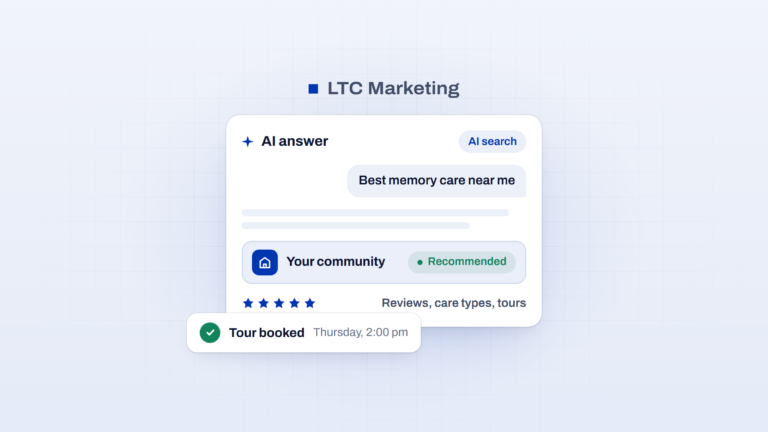
- Be named where families search. Google now shows an AI answer above the results for many searches such as “assisted living in [town],” and more families ask ChatGPT. A clear page for each community and care type, a complete Google Business Profile and a steady flow of reviews give those answers something to cite. Our senior living SEO and AI answers page covers this work.
- Run paid search on the searches families make, within Google’s rules for housing ads.
- Answer every inquiry fast. In Bild & Co.’s 2023 mystery shops of more than 250 communities, 53% of web inquiries got no reply within two hours, and 13% of calls never got a response at all. A direct inquiry saves the fee only if someone answers it.
- Record the source of every move-in. When your CRM shows which inquiry each new resident came from, a monthly report can set referral fees next to the cost of your own channels, community by community.
We have marketed more than 100 senior living communities and generated thousands of leads for them, and those leads go straight to the community with no referral fee. One new memory care community we launched in 2020 reached 5,000 visits and more than 50 leads a month, and held that for two years.
Questions operators ask about referral fees
Is A Place for Mom free?
For families, yes. A Place for Mom says it is paid by participating communities when a family it referred moves in.
Does a community pay for referrals that never move in?
A Place for Mom’s site describes payment on move-in. Caring.com says some providers pay for each family’s contact details it sends, whether or not the family moves in. Your contract says which one applies to you.
How long after a referral can a fee still apply?
Caring.com’s Oregon disclosure gives a range from six months to an indeterminate period, depending on the contract. Check the window in every referral agreement you hold.
Should we stop using referral sites?
Not necessarily. They bring families you might not reach on your own. The useful numbers are the share of your move-ins that carries a fee and what your own channels cost per move-in. Once both sit in one monthly report, you can decide how much to rely on referral sites. Our free audit shows, for each of your communities, where families find you today and which referral sites appear above you. You can request it on our senior living page.
Sources
- A Place for Mom, Eldercare advisors (how the company is paid, network size), read November 2026.
- Senior Housing News, US Senator Probes A Place for Mom, Alleging ‘Deceptive’ Practices, June 20, 2024.
- Caring.com, How we make money and Oregon long-term care referral agent disclosure, read November 2026.
- CareScout, Cost of Care Survey, 2025 survey.
- The Motley Fool, Sonida Senior Living Q2 2025 results, August 11, 2025.
- WelcomeHome, 2025 Q2 benchmark review, July 28, 2025.
- Senior Housing News, Senior Living Operators Level Up Sales to Beat Alarming Trends in Conversions (Bild & Co. mystery shop data), February 12, 2024.
Disclaimer: We are a marketing company, not a legal one. Nothing in this article constitutes legal advice; all information, content, and materials available on this site are for general informational purposes only.

Roman ZelvenschiChief Storyteller
Roman Zelvenschi is a digital marketing strategist and founder with over 15 years of experience helping businesses grow through data-driven marketing and brand strategy. Since 2008, he has turned ideas into profitable, scalable ventures—working with brands ranging from global enterprises like Mondelēz to startups such as The Kosher Express. His expertise lies in SEO, AI-driven marketing, and lead generation, particularly within highly regulated industries such as healthcare, long-term care, and finance. Roman believes effective marketing blends brand investment for long-term growth with short-term performance through lead generation and customer lifetime value optimization. An early adopter of AI in marketing, Roman has leveraged machine learning since 2022 to enhance targeting, personalization, and campaign performance. He continues to advocate that technology should amplify human creativity—not replace it.
Schedule a Call