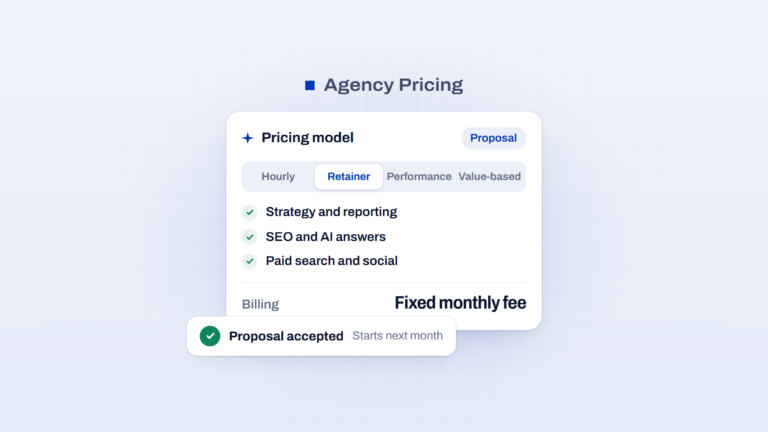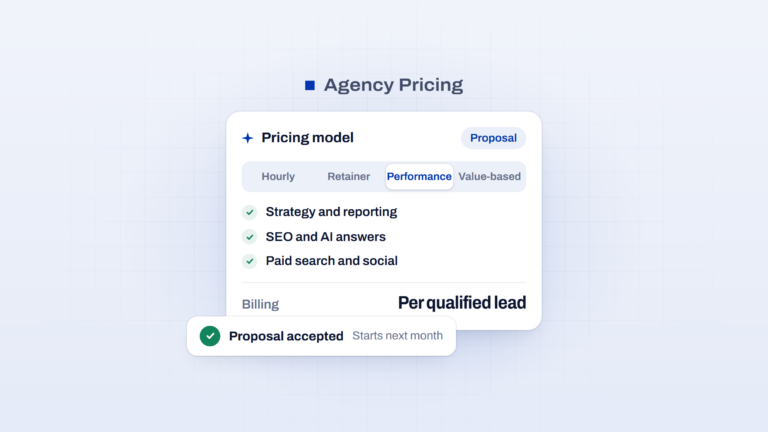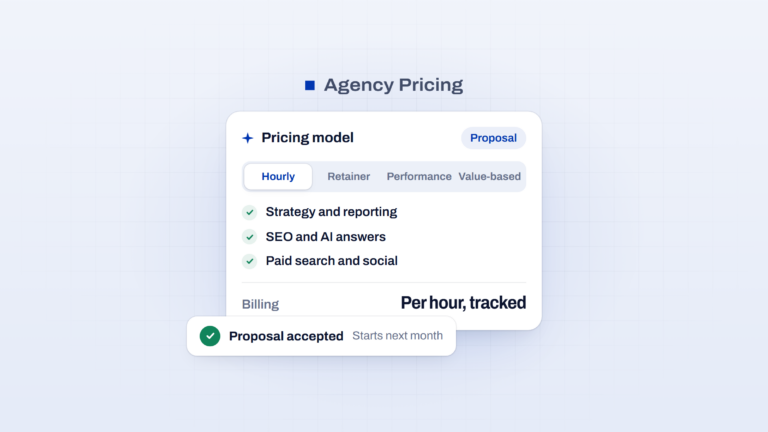


In digital marketing, the value-based payment model ties the agency’s fee to the value its work creates. It correlates the agency’s fees with the significant influence and worth it provides to the client. This pricing package is commonly used to charge for specific services or an agency’s expertise, which have a significant impact on the client’s success.
Advantages of Value-Based Pricing
for the agency
- Rewards Expertise: Marketing agencies can demand higher fees that match the exceptional value they provide.
- Strengthened Client Relationships: Agencies can build solid and lasting relationships by profoundly understanding their client’s business landscape.
- Enhanced Profit Margins: When a marketing agency shows its worth, it can charge based on value instead of time or resources.
for the client
- ROI-Centric: Clients feel more confident as their payments correlate directly with the expected value or ROI.
- Simplified Budgeting: The value-based model simplifies budgeting, avoiding the fluctuations of hourly or performance-based fees.
- Unified Vision: The client and agency are oriented towards achieving high value, leading to a shared vision for the project.
Challenges of Value-Based Payment Method
for the agency
- Justifying the Cost: A healthcare agency must continually validate and articulate the delivered value, which can be a challenging task.
- Revenue Variability: Agency earnings may decrease if the perceived value decreases or if they fail to deliver the promised value.
- Scope Creep Risk: Vague deliverables may prompt clients to expect beyond the initial agreement, potentially leading to conflicts.
for the client
- Higher Upfront Costs: Clients might perceive value-based pricing as costlier than other models at the outset.
- Value Expectation Gaps: If expectations aren’t managed, clients might feel they’re overpaying for the results they receive.
- Lack of Transparency: It might be easier for clients to understand how the pricing was determined with an hourly or performance metric.
Balancing Risks and Rewards of Value-based Pricing
Risks
for the agency
- Cost Justification: If the client doesn’t acknowledge the value produced, it could damage the partnership.
- Client Turnover: The digital marketing agency might face a cycle of one-time projects and a continuous search for new clients.
for the client
- Value Delivery: There’s a gamble involved; if the agency underperforms, the client might spend a lot of money with very little return on investment.
Rewards
for the client
- Do What You Love: The agency can focus on quality and value over quantity.
- Higher Earnings: Agencies are compensated generously for their most effective work rather than the volume of hours spent.
for the agency
- Highest ROI: The client gets tailored, value-oriented solutions that are expected to increase ROI.
Value-Based Contracting: Ideal Scenarios
- Specialized Expertise or Unique Services: If the agency offers services that few others can or has particular expertise that can bring significant value.
- High Impact Decisions: When the agency’s involvement or actions have a substantial impact on a client’s profitability, particularly regarding critical business strategies.
- Tangible ROI: If the agency’s services can lead to heightened revenue, cost savings, or other measurable ROI for the client.
- Solutions with Long-Term Benefits: When the agency’s work promises enduring benefits, such as a branding strategy that stands the test of time.
When to Avoid Value-Based Pricing Strategy
- Ambiguous Value Metrics: Pricing disputes can arise when there is no straightforward method to quantify the value of services.
- Multiple Stakeholders: With numerous stakeholders, establishing a universally satisfying price can be challenging.
- High Risk, Uncertain Outcome: In projects where the outcome is uncertain or the risk is high, agencies may find it difficult to set a price that adequately compensates for their risks.
A sample value-based proposal (an invented example)
The business below is invented to show the math. It is not a client of ours, and the figures are illustrations.
A subscription health box company has 10,000 subscribers at $50 a month, or $6 million a year. The agency estimates its work could add 3,000 new subscribers and keep 1,500 who would otherwise cancel:
| Source of added revenue | Subscribers | Added revenue in a year |
|---|---|---|
| New subscribers | 3,000 | $1.8 million |
| Fewer cancellations | 1,500 | $900,000 |
| Total | 4,500 | $2.7 million |
A value-based fee of 10% of the added revenue in the first year would be $270,000. The model only works if both sides agree in advance how the added revenue is measured, and what happens to the fee if the estimate isn’t met.
How we price our own work
Our engagements start from a monthly fee of $3,500 (USD) for the work in a plan we agree with you, with ad spend paid directly to Google or Microsoft. Our pricing page explains what the fee covers, and our guide to agency pricing models compares the four models.
Disclaimer: We are a marketing company, not a legal one. Nothing in this article constitutes legal advice; all information, content, and materials available on this site are for general informational purposes only.

Roman ZelvenschiChief Storyteller
Roman Zelvenschi is a digital marketing strategist and founder with over 15 years of experience helping businesses grow through data-driven marketing and brand strategy. Since 2008, he has turned ideas into profitable, scalable ventures—working with brands ranging from global enterprises like Mondelēz to startups such as The Kosher Express. His expertise lies in SEO, AI-driven marketing, and lead generation, particularly within highly regulated industries such as healthcare, long-term care, and finance. Roman believes effective marketing blends brand investment for long-term growth with short-term performance through lead generation and customer lifetime value optimization. An early adopter of AI in marketing, Roman has leveraged machine learning since 2022 to enhance targeting, personalization, and campaign performance. He continues to advocate that technology should amplify human creativity—not replace it.
Schedule a Call