
Hourly Rate Pricing in Digital Marketing: Pros, Cons and a Sample Project
In the digital world, considering the right pricing package can be a complex puzzle for digital marketing agencies and businesses. The hourly rate model is a popular option, but is it still relevant in today’s fast-evolving world? As we delve deeper into the article, we will explore the benefits and risks associated with hourly rate pricing and work through an invented example.
The True Essence of Hourly Rate Pricing
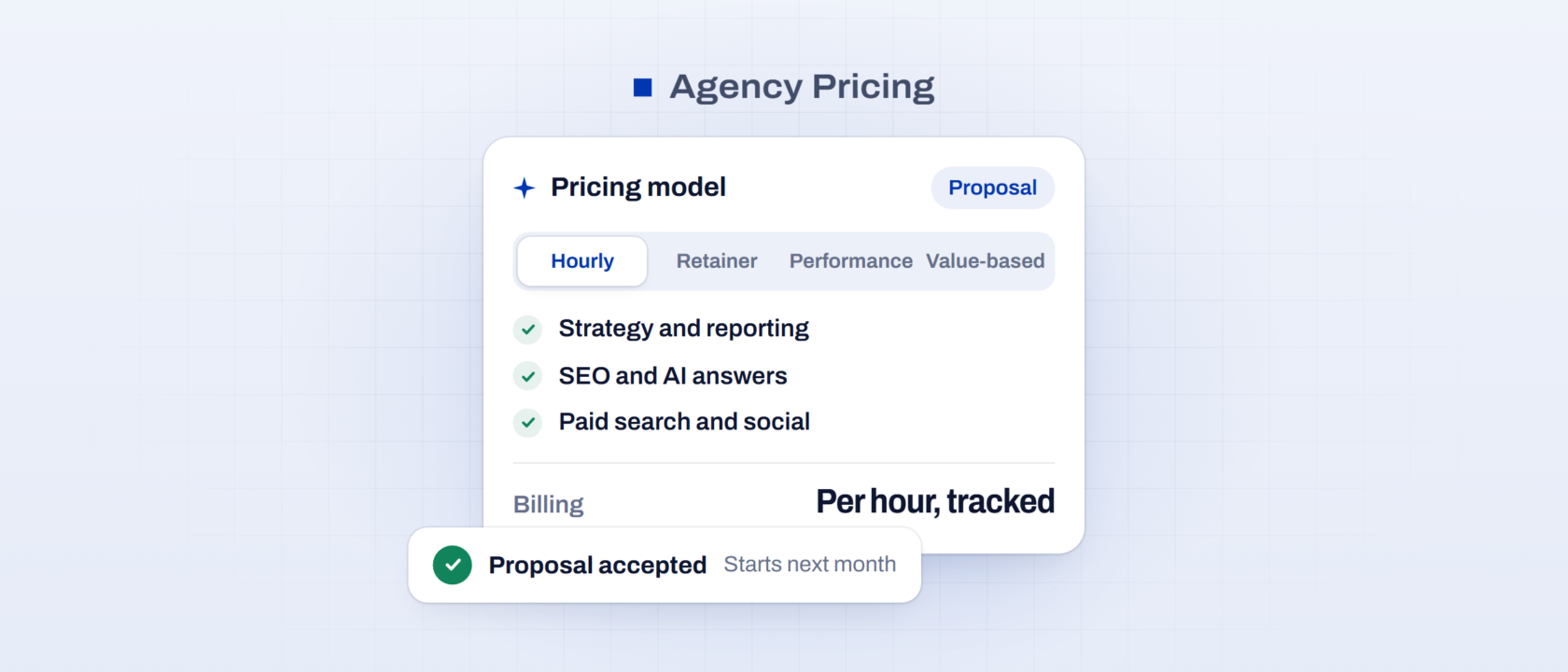
In simple terms, the hourly pricing model charges clients based on agency hours spent on the project. It is often the starting point of a relationship between two parts.
It is important to note that hourly rates can have some drawbacks and may be unpredictable. However, there are situations where hourly prices can be beneficial. Therefore, this pricing strategy presents a low-risk, low-reward option for both the agency and the client.
Benefits of Hourly Pricing
For the agency
- Low Commitment: The agency can evaluate the client before engaging in a long-term relationship.
- Reward Effort: The agency gets paid for each hour of work.
For the client
- Low Commitment: The client evaluates the agency before engaging in a long-term relationship.
Cons of Hourly Pricing
For the agency
- There is no predictable income.
- It takes a lot of work to allocate dedicated resources.
- There is a growing need for more reporting.
- Not all work is billable hours (reporting, email, phones).
- It’s tough to calculate the actual cost per hour internally.
For the client
- It is hard to shop around as the hourly rate doesn’t consider efficiency and impact. Our agency might do it in 4 hours, but it will take 12 hours for others.
- It is hard to have an agency at your service since most agencies focus on clients with predictable incomes.
- Encourages the agency to devote more time to the task, whereas it’s better for the client if tasks are completed more quickly.
- On projects with unpredictable scope, it might become very costly.
- The financial forecast is uncertain and complex to predict.
- There is a need to evaluate reports.
Summary of Pros and Cons of Hourly Rates Package
Hourly pricing has pros and cons for both agencies and clients.
- Agencies can charge for every work hour but may face the risk of unpredictable income and added extra tasks.
- Clients can choose among flexible agencies, but they may need help in assessing efficiency and budget forecasting.
- Understanding hourly reports is crucial for both parties.
Hourly Rate Pricing Strategy Risks vs. Rewards
For the agency
Risks
- The agency spends a lot of time onboarding a client who leaves after the initial few hours.
- The client is not willing to pay for all the hours worked.
Rewards
- This pricing model may result in overpayment compared to other pricing packages.
- The delivery of the requested tasks may take longer than usual.
For the client
Risks
- The ability to showcase effect without asking for a long-term commitment exists.
- The agency can earn additional income beyond standard retainers.
Rewards
- The client can pay for only a few work hours to resolve significant issues.
- The client can evaluate the agency without a long-term commitment.
Summary of Risks vs. Rewards of Hourly Rates Pricing Model
Undoubtedly, hourly pricing in digital marketing has risks and rewards for both sides.
- Agencies can earn extra income and showcase their capabilities without long-term commitments but risk investing time in short-term clients.
- Clients gain flexibility but may pay more and face longer wait times.
When is Hourly Pricing Ideal?
- When initiating a partnership with an agency, you might consider assigning them a trial project to assess their capabilities before fully committing to a comprehensive collaboration.
- When you have a specific issue and need a specialist to resolve it. For example, your conversion tracking is off, and you need someone to fix it ASAP to keep running campaigns.
Hourly Pricing Tips
Understand Work Hours vs. Consultant Hours
- Work: I consider our overhead staff rates and margins needed when we work on hourly rates. Hourly rates vary widely across the industry.
- Consulting: The client doesn’t need us to do much work; they seek expertise or insight that might influence a strategic decision. In this scenario, an agency or consultant charges more per hour. The price depends on the uniqueness of knowledge and business impact.
Put Hourly Limits
You can always limit how many hours you are willing to pay for and ask the agency to update you on the hours spent.
When Hourly Pricing Doesn’t Work
For the agency
For the client
The client is trying to get a lot without paying for the required hours. For example, we got an RFP asking to consult the in-house Paid Team and to come up with the first meeting with three ways to improve their existing setup. They wanted to pay for one or 2 hours of us talking to the in-house team.
However, to provide real work – we would need a lot more hours to audit all of their ad accounts, conversion tracking, and metrics, meet with the team to discuss improvements, develop the strategy doc, and finally talk to them. That’s more like a 30-hour job, considering the size of their campaign.
Deliverables take incredibly long to accomplish. Remember, the hourly rate should consider the whole team working on the project – so if it’s a personal team and in the scope it says 10 hours for deliverables – that’s 40 hours; it needs to make sense.
You are paying for the agency learning stuff; for example, if a person in the agency is unfamiliar with GA4 – you shouldn’t be paying for them to research how to use it.
A sample hourly project (an invented example)
The business below is invented to show how an hourly project is scoped. It is not a client of ours.
A boutique fitness studio wants to know which ads and pages bring class bookings. The project has three parts: an audit of the website and booking system (2 hours), the conversion tracking setup (6 hours) and the tests (2 hours), about 10 hours in all, billed at the agency’s hourly rate with a cap the studio approves first.
The hourly model suits this job. The scope is small and clear, the studio pays only for the hours used, and the cap protects it from overruns. It would suit a year of SEO badly, because the hours are hard to predict and nobody can plan the work around them.
For comparison, our Google Ads campaign setup is a one-time fee of $1,600, and ongoing work is a monthly fee from $3,500 (USD). Our pricing page explains both, and our guide to agency pricing models compares hourly pricing with the other three models.
Making the Right Choice with Roman Agency
To achieve financial efficiency in digital marketing, understanding pricing strategies is crucial. Although the hourly pricing model has benefits and challenges, selecting one that closely matches your business needs and objectives is vital.
Explore our comprehensive services and let us guide you toward the best pricing strategy for your business. Take the first step today!

Roman Zelvenschi
Chief Storyteller
Disclaimer: We are a marketing company, not a legal one. Nothing in this article constitutes legal advice; all information, content, and materials available on this site are for general informational purposes only.

Roman ZelvenschiChief Storyteller
Roman Zelvenschi is a digital marketing strategist and founder with over 15 years of experience helping businesses grow through data-driven marketing and brand strategy. Since 2008, he has turned ideas into profitable, scalable ventures—working with brands ranging from global enterprises like Mondelēz to startups such as The Kosher Express. His expertise lies in SEO, AI-driven marketing, and lead generation, particularly within highly regulated industries such as healthcare, long-term care, and finance. Roman believes effective marketing blends brand investment for long-term growth with short-term performance through lead generation and customer lifetime value optimization. An early adopter of AI in marketing, Roman has leveraged machine learning since 2022 to enhance targeting, personalization, and campaign performance. He continues to advocate that technology should amplify human creativity—not replace it.
Schedule a Call